FOCISelector#
- class pyFOCI.FOCISelector(max_features=None, min_delta=0, *, method='r_foci', standardize='normalize', rank_method='max', nn_strategy='grouping', nn_tie_breaking='random', random_state=None, n_jobs=None)#
Feature selector using hierarchical forward selection based on the nonlinear Azadkia–Chatterjee T_n coefficient, using the FOCI R reference form by default and the Fuchs form as an alternative (see references).
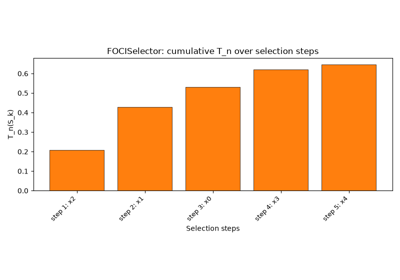
At each step, among remaining features, we choose the feature that maximizes the per-step score on the growing set S_k = S_{k-1} ∪ {j}.
- Parameters:
- max_featuresint or None, default=None
Maximum number of features to select. If None, no hard cap is applied and selection proceeds until early stopping (if
min_deltais not None) or until all features are selected (ifmin_deltais None).- min_deltafloat or None, default=0
Minimum required improvement in the selection score to continue selecting. Behavior:
First step: select a feature only if best_score > min_delta; otherwise, select none.
Subsequent steps: continue only if best_score > previous_best + min_delta; otherwise, stop.
None disables early stopping (select up to
max_features).
Notes:
min_delta can be negative to relax stopping, 0 to reproduce standard early stopping, and positive to require stricter improvement.
Compatibility with the reference implementation:
min_delta == 0 corresponds to stop=TRUE
min_delta is None corresponds to stop=FALSE
- method{“r_foci”, “fuchs”}, default=”r_foci”
Selection scoring method:
“r_foci” (default): Azadkia–Chatterjee \(Q_n/S(y)\) numerator/denominator form, matching the FOCI R reference implementation’s selection and stopping.
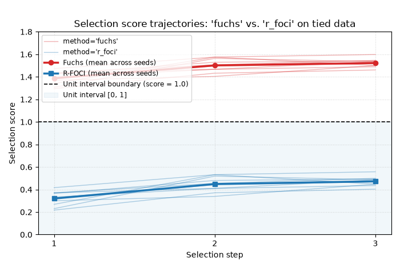
“fuchs”: Fuchs (2024) closed-form score.
- standardize{“normalize”, None}, default=”normalize”
If “normalize”, each column of X is standardized to zero mean and unit variance before computing nearest neighbors. If None, X is used as-is. Columns with zero variance are left unchanged.
- rank_method{“max”, “average”}, default=”max”
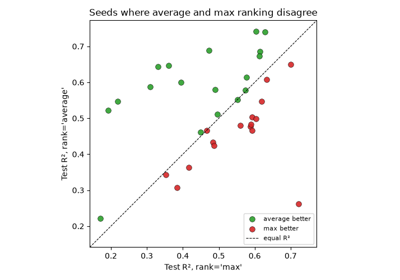
Method used to assign one-based ranks to the target values. If “max”, tied values receive the maximum rank in their tie group. If “average”, tied values receive the average rank in their tie group.
- nn_strategy{“grouping”, “radius”}, default=”grouping”
Strategy used to compute nearest neighbor tie sets. Ignored when
nn_tie_breaking="first".- nn_tie_breaking{“random”, “mean”, “first”}, default=”random”
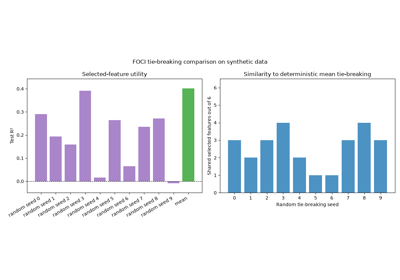
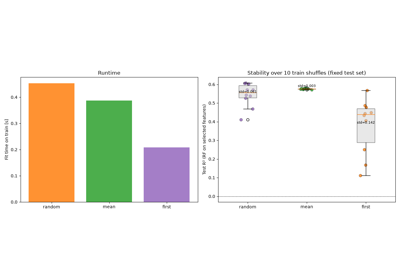
How to resolve ties among equally-distanced nearest neighbors. If “random”, one tied neighbor is selected at random. If “mean”, the mean target rank across all tied neighbors is used. If “first”, a single nearest neighbor per sample is queried; the first one returned by the nearest-neighbor method is used without computing tie sets. This option is available to study its impact on the outcome, stability and speed of the algorithm.
- random_stateint, RandomState instance or None, default=None
Controls the random tie-breaking among nearest neighbors. Only used for
nn_tie_breaking="random". Pass an int for reproducible results across multiple calls. If None, the global NumPy random state is used.- n_jobsint or None, default=None
Number of parallel worker processes used to score candidate features in each forward-selection round.
Noneand1score candidates sequentially.-1uses all available processors; values below-1follow joblib’s convention. A fixed integerrandom_stateassigns deterministic random streams per candidate, so results are reproducible and identical across worker counts.
- Attributes:
- n_features_in_int
Number of features seen during fit.
- feature_names_in_ndarray of shape (
n_features_in_,) Feature names seen during fit. Defined only when X has feature names.
- support_mask_ndarray of shape (
n_features_in_,), dtype=bool Boolean mask of selected features determined during fit.
- score_path_ndarray of shape (n_selected,)
Values of the per-step selection scores; their interpretation depends on
method.
References
Mona Azadkia and Sourav Chatterjee. A simple measure of conditional dependence. The Annals of Statistics, 49(6):3070–3102, 2021. https://doi.org/10.1214/21-AOS2073
R FOCI package (reference implementation): https://cran.r-project.org/package=FOCI
Sebastian Fuchs. Quantifying directed dependence via dimension reduction. Journal of Multivariate Analysis 201 (2024): 105266. https://doi.org/10.1016/j.jmva.2023.105266
Methods
fit(X, y)Fit the selector by hierarchical forward selection maximizing the per-step score (see
method) over the growing feature set.fit_transform(X[, y])Fit to data, then transform it.
get_feature_names_out([input_features])Mask feature names according to selected features.
Get metadata routing of this object.
get_params([deep])Get parameters for this estimator.
get_support([indices])Get a mask, or integer index, of the features selected.
Reverse the transformation operation.
set_output(*[, transform])Set output container.
set_params(**params)Set the parameters of this estimator.
transform(X)Reduce X to the selected features.
- fit(X, y)#
Fit the selector by hierarchical forward selection maximizing the per-step score (see
method) over the growing feature set.- Parameters:
- Xarray-like of shape (n_samples, n_features)
Training input samples.
- yarray-like of shape (n_samples,)
Target values.
- Returns:
- self
- fit_transform(X, y=None, **fit_params)#
Fit to data, then transform it.
Fits transformer to
Xandywith optional parametersfit_paramsand returns a transformed version ofX.- Parameters:
- Xarray-like of shape (n_samples, n_features)
Input samples.
- yarray-like of shape (n_samples,) or (n_samples, n_outputs), default=None
Target values (None for unsupervised transformations).
- **fit_paramsdict
Additional fit parameters. Pass only if the estimator accepts additional params in its
fitmethod.
- Returns:
- X_newndarray array of shape (n_samples, n_features_new)
Transformed array.
- get_feature_names_out(input_features=None)#
Mask feature names according to selected features.
- Parameters:
- input_featuresarray-like of str or None, default=None
Input features.
If
input_featuresisNone, thenfeature_names_in_is used as feature names in. Iffeature_names_in_is not defined, then the following input feature names are generated:["x0", "x1", ..., "x(n_features_in_ - 1)"].If
input_featuresis an array-like, theninput_featuresmust matchfeature_names_in_iffeature_names_in_is defined.
- Returns:
- feature_names_outndarray of str objects
Transformed feature names.
- get_metadata_routing()#
Get metadata routing of this object.
Please check User Guide on how the routing mechanism works.
- Returns:
- routingMetadataRequest
A
MetadataRequestencapsulating routing information.
- get_params(deep=True)#
Get parameters for this estimator.
- Parameters:
- deepbool, default=True
If True, will return the parameters for this estimator and contained subobjects that are estimators.
- Returns:
- paramsdict
Parameter names mapped to their values.
- get_support(indices=False)#
Get a mask, or integer index, of the features selected.
- Parameters:
- indicesbool, default=False
If True, the return value will be an array of integers, rather than a boolean mask.
- Returns:
- supportarray
An index that selects the retained features from a feature vector. If
indicesis False, this is a boolean array of shape [# input features], in which an element is True iff its corresponding feature is selected for retention. Ifindicesis True, this is an integer array of shape [# output features] whose values are indices into the input feature vector.
- inverse_transform(X)#
Reverse the transformation operation.
- Parameters:
- Xarray of shape [n_samples, n_selected_features]
The input samples.
- Returns:
- X_originalarray of shape [n_samples, n_original_features]
Xwith columns of zeros inserted where features would have been removed bytransform().
- set_output(*, transform=None)#
Set output container.
Refer to the user guide for more details and Introducing the set_output API for an example on how to use the API.
- Parameters:
- transform{“default”, “pandas”, “polars”}, default=None
Configure output of
transformandfit_transform."default": Default output format of a transformer"pandas": DataFrame output"polars": Polars outputNone: Transform configuration is unchanged
Added in version 1.4:
"polars"option was added.
- Returns:
- selfestimator instance
Estimator instance.
- set_params(**params)#
Set the parameters of this estimator.
The method works on simple estimators as well as on nested objects (such as
Pipeline). The latter have parameters of the form<component>__<parameter>so that it’s possible to update each component of a nested object.- Parameters:
- **paramsdict
Estimator parameters.
- Returns:
- selfestimator instance
Estimator instance.
- transform(X)#
Reduce X to the selected features.
- Parameters:
- Xarray of shape [n_samples, n_features]
The input samples.
- Returns:
- X_rarray of shape [n_samples, n_selected_features]
The input samples with only the selected features.